Charles Dickens, in a Preface to The Christmas Carol


“I have endeavored in this Ghostly little book, to raise the Ghost of an Idea, which shall not put my readers out of humour with themselves, with each other, with the season, or with me. May it haunt their houses pleasantly.......” Charles Dickens, in a Preface to A Christmas Carol

Monday, March 28, 2011

The Many Faces of Easter Egg Art

I would like to share with you my most comforting Easter quote:
"Advantage #2 of Old Age Memory Loss:  You can hide your own eggs."

Some of my favorite Easter egg images are below. I hope you enjoy them over and over, as if you had never seen them before....
1.  Eggs Painted and Decorated, from the simple to the lavish
2.  Edible Eggs
3.  Works of Art composed of Easter Eggs, and
4.  The Largest Easter Eggs in the World, including the largest chocolate egg, which I truly covet

EGGS PAINTED AND DECORATED

Egg painting is an artform that is practiced by children, their parents, and artists.  Anyone can create at least one of these... from the simplest dyed eggs....


to hand-painted eggs with floral motifs.....


                                to whimsically painted eggs...


to marbled eggs...


to egg homages of favorite movie and tv show characters, like those from Battlestar Galactica and Star Wars....
http://www.geeksaresexy.net/2010/04/02/
battlestar-galact-egg-a-
geeking-out-with-easter-decorations/


http://starwarsblog.starwars.com/index.php/2009/04/10/star-wars-egg-art/


to one-of-a-kind eggs painted by talented artists, like Delia Pacheco,
 http://www.squidoo.com/one_of_a_kind_painted_easter_eggs)


to eggs fit for a golden goose....


to "grunge" eggs, nestled in a traditional basket....
Photo:  Tony Horpel


to "humpty dumpty" eggs from a store window in the resort of Sandpoint, Idaho...

to eggs with painted folk stories...

or eggs with religious motifs, such as this one from Bucharest, Romania...


Of course, you don't have to always paint Easter Eggs.

You may wrap them with ribbons....


or tie them with bows....


or embroider them.....


or knit over them...


or make them from felt...


or fabric....

or decorate them with wire....


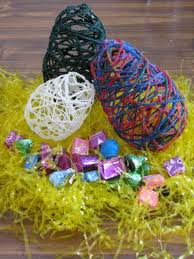
or wrap them in string....


or carve them in intricate designs....


You may wish to bead them....


Or, if you are Peter Carl Faberge, the jeweler to the Tsar of Russia, you may wish to craft them from gold and enamel, and include an Easter surprise inside...
EDIBLE EASTER EGGS  Your favorite eggs, however, may be the edible eggs.....

like chocolate eggs...

or jelly bean eggs....
or sugar eggs....
or cookie eggs....


or cereal eggs...

or egg cakes...


LARGE WORKS OF EASTER EGG ART  Of course, individual eggs can be put together to create wonderful works of art.
Detail


Absolutely wondrous is this portrait of the Virgin Mary created by Ukranian artist Oksana Mars, using 15,000 painted eggs.  Displayed in 2010 in Saint Sophia Cathedral in Kiev, the mosaic weighed 2.5 tons and measured 7 X 7 meters.


Here is a full view of the Virgin Mary Easter Egg mosaic.  More information can be found at the following website:  http://www.odditycentral.com/pics/virgin-mary-mosaic-made-from-15000-easter-eggs.html


In Saalfeld, Germany, Voker Krafte created an Easter egg tree marvel....


                    Up close, you can see the variety of intricately-crafted eggs...

THE LARGEST EGGS IN THE WORLD  The title for the largest Easter egg in existence is hotly contested.

The Canadian town of Vegreville claims that their 25.7 foot long aluminum egg is the biggest ever constructed.  It was installed in 1975 to commemorate early Ukrainian settlements near Edmonton.


The city of Suceava, Romania lays claims for the largest painted Easter egg, measuring 7.25 meters high.  It is decorated with traditional patterns of red, symbolizing the blood of Jesus; black symbolizing eternity; and yellow, symbolizing light.


Flickr, from Mia
The entrance to a museum in Koloyia, Ukraine, also lays claim as the largest Easter egg.  It is 14 meters high, and 10 meters wide.  The museum has a collection of over 10,000 Easter eggs from not only the Ukraine, but Belarus, Poland, Sweden, France, Pakistan, the US, and India, among others.  For more info, go to www.armchairtravelogue.blogspot.com


The Guinness Book of World Records claims that this chocolate egg, made in 2005 in Sint Niklaas, Belgium, is the largest ever created. Produced by the famous chocolatier Guylian, it measures 8.32 meters high.  It took 26 craftsmen 525 hours to build the egg, using 4300 pounds of chocolates.  There are about 9000 calories in a pound of chocolate.  If I ate the whole thing....which I could.... I would consume 38,700,000 calories.


Finally, breaking no record that I am aware of, here is an egg painted and planted in a square in Zabreg, Yugoslavia.  A view from one side.........


and then the other.....

Wednesday, March 23, 2011

The Origins and History of Easter Eggs: Dept 56 and Much More

Department 56 villages bring to life our Easter traditions.  We find churches, parishioners, Easter bunnies, Easter egg hunts, chocolate eggs, and so much more.  To appreciate these traditions more fully, I have explored various theories on the symbolism and history of eggs, particularly Easter eggs, in our western culture.  From a myriad of internet sources, I have teased out some information that strikes me as plausible, as well as interesting.

Persepolis,
National Geographic
Zoroastrians and Persepolis  The earliest indications of the use of ceremoial eggs may date from the Zoroastrians in Persia, which is modern-day Iran, in the 6th century BCE.  Sculptures of people carrying eggs can be found on the walls of Persepolis, which was an ancient Persian city about 40 miles northeaster of present-day Shiraz, Iran.  The painted eggs were for the king to celebrate Nowrooz, their New Years celebration, which fell on the spring equinox.

Dept 56, Christmas in the City,
"Central Synagogue," 56. 59204
Jewish Traditions  During the Seder meal for Passover, Jews serve a hard-boiled egg.  According to several sources, the egg symbolizes 1) the sacrifice brought by the Hebrews to the Temple in Jerusalem in biblical times, and 2) the mourning for the destruction of the Temple in both the 6th century BCE and the 1st century AD.  For these reasons, the egg also became a traditional food for those in mourning.  For more information, go to this link:  http://www.angelfire.com/pa2/passover/faq/seder-plate.html

St. Bede the Venerable
Eostre and Gregory the Great  In the 7th century, an English monk, given the name of the Venerable Bede, wrote a text called "The Reckoning of Time," (Temporum Ratione).  It was about the solar and lunar cycles, and included a chapter on "months," or times of the moon.  According to Bede, April was called Eosturmonath,  named after the goddess of fertility, Eostre. www.manygods.org.uk/articles/essays/Eostre.shtml

Pope Gregory the Great
The symbol of Eostre was said to be an egg, which was associated with fertility.  Pope Gregory the Great, who created the goal to convert the English Isles, wrote in the 6th century that pagan rituals should be adapted to the "praise of God," rather than dismissed.  It is not a stretch to believe that Irish pagan customs concerning eggs were absorbed into Christian culture, just as Christmas trees were adopted from non-Christian sources.

Dept 56, Christmas in the City,
"Cathedral of St. Nicholas," 56.59248
Christian Egg Traditions  In Orthodox traditions, eggs are frequently dyed red to represent the blood of Christ.

Icon of Mary Magdalen,
with words on the red egg,
"Christ is Risen"
This practice may be based on a legend that Mary Magdalen met with the Emperor Tiberius in Rome to tell him about Jesus and the Resurrection, offering him an egg as a symbol of this event.  Scornfully Tiberius  protested that a man could no more rise from the dead than that egg could turn scarlet.  As he said it, legend says that the egg turned red in Mary Magdalen's hands.  Frequently, images of her will include a red egg.

Dept 56, Snow Village,
"Happy Easter Church," 56.55325
For Western Christians, the egg symbolizes a complex of simple, but very profound ideas, probably adopted from many religions and cultures:  potential; rebirth; hope; resurrection;  renewal; metamorphosis from one life to another; rejuvenation.  Another author adds a further level of symbolism:  "...the egg represents the Creation, the elements, and the world itself, with the shell representing the firmament, the vault of the sky where the fiery stars lie; the thin membrane symbolizing air; the white symbolizing the waters; and the yolk representing the earth."   http://www.fisheaters.com/symbols.html

In my next blog I will take you on a tour of Easter eggs, painted, sculpted, wired and embroidered!

Saturday, March 19, 2011

Department 56: Evoking Easter Memories

Easter is delightful, and Department 56 has found a way to bring back joyful memories of traditions played out during every spring of my childhood.

Dept 56, Snow Village,
"Easter Egg Painting Studio," 56.55385
Dyeing Easter Eggs  This delightful pastel building is obviously a master rabbit's dyeing studio and school.  Admission standards to the Egg Painting Studio are high, resulting in an immensely qualified and creative student body.  Peter Cottonfur and other students study the art of egg preparation, pigment production, egg decoration, drying processes, basket procurement, and egg distribution schemes.  Though the students grow weary of the daily routines, they know that becoming a certified master of egg painting will give them artistic license to create their own lines for discriminating buyers at the finest shops, Bloomingeggs, Eggcy's, Neiman Mareggs, and Sak's Fifth Eggsenue.

Depart 56, Snow Village,
"It's the Easter Bunny!" 56.55164
Easter Bunnies  While Easter Bunnies take their professions seriously, they recognize that it is seasonal employment.  They do have continuing education, mostly during the summer, including courses on public relations and product distribution techniques. In the fall, Easter bunnies embark on a severe regimen of physical training to preparing for the arduous job of hauling around millions of baskets and tons of eggs in such a short period of time.  It isn't just carrying heavy baskets, it is the constant squatting down and standing up, necessary in the egg hiding process, that wreaks havoc on bunnies' knees.  Attempts at Easter Bunny unionization have failed, given that most professional bunnies wish to maintain independence in their artistic endeavors and personal relationships with children.

Dept 56, Snow Village,
"One Hop Walk," 56.55160
Green Grass and Warm Sunshine    Easter Village Event Planners take great care in the production of the best possible traditional holiday activities, including Easter Egg Dyeing for Amateurs;  Easter Egg Hunts for Children; fashion acquisition of adorable, yet up-to-date, attire, particularly for infants and children; and other pursuits that will create lifelong memories.  However, the most difficult job for the Easter Event Planner is to ensure sunshine, green grass, and cheerful flowers.  Given web technology, it is easy to identify Easter dates far in advance, and to plant adequate acreage of seasonally-appropriate flower species.  However, the procurement of good weather is very complicated, and only journeyman level Easter Event Planners have mastered the art.

Dept 56, Dickens Village,
"A Basket Full of Blooms," 56.58583
Beautiful Flowers  Easter lilies are symbolic, elegant, fragrant, and evocative, and necessary to lifelong Easter memory-making.  The natural white shade of Easter lilies is the color standard used by Master Egg Painters in selecting perfectly "white" eggs for their best artistic pieces. Easter bunnies have long favored Easter lily foliage as a perfect natural background for pastel eggs.

Dept 56, Snow Village,
"Lily's Nursery and Gifts," 56.55095


Easter Event Planners can count on adequate supplies of Easter lilies to embellish any party venue, in part due to Lily's Nursery and Gifts, which always plans for all the lilies that Easter requires.

Dept 56, Snow Village,
"Dressed in Our Easter
Best," 56.55327
Easter Clothes  A prerequisite for any Easter event, and the making of any Easter memory, is new finery.  Stylish new clothes serve to celebrate renewal, the beginning of spring, the celebration of life.  New Easter attire has lately been ignored in favor of the practical jeans and t-shirts.  However, childhood memories can tell of us days past, when a new dress, new hat, new shoes, or new jacket made us smile. Dressed in Our Easter Best


Dept 56, Christmas in the City,
"Window Shoppers," 56.59481
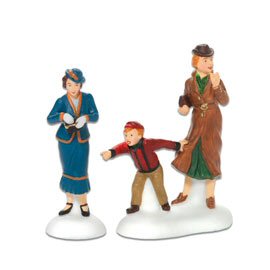
In urban areas, such as CIC, elegant and festive Easter parades afford men and women the opportunity to gather, mostly to see what everyone else was wearing.  Especially anticipated are the big hats, with feathers, and flowers, and even birds perched in netting.  Children are not allowed to laugh and point at the hat birds.  Parents admonish them, with threats that the Easter Bunny will not visit.  Development of Child Manners is also a course at the Easter Egg Painting Studio.  It is taken very seriously. 


Dept 56, Snow Village,
"Happy Easter Church,'
56. 55325
Easter Morning Church  Many show off their new finery for the first time on Easter morning at church.  Easter is the best time ever at church, especially when coffee and donuts are served afterwards, and everyone is smiling.  Sometimes the Easter Bunny forms an alliance with the pastor of the church for an egg hunt post-service, but more frequently the egg hunt is at home or a local park.

Dept. 56, Snow Village,
"Easter Egg Hunt," 56.55326


Easter Egg Hunts  The highlight of Easter for many young children is the Easter Egg Hunt.  Of course, the Easter Bunny knows this, and is careful to search out hiding places that are age-appropriate for the family.  A one-unit course at the Easter Egg Painting Studio, called "Demographics and the Egg Hiding Paradigm," is required for all certified Easter Bunnies. Quite rightly.

The hunt frequently takes place right after church, during which the children display extraordinary anticipation, and before lunch, which leaves them so hungry that they tend to indulge in "Sucrose Satiation," a malady common to children that affects not them, but their parents.

Dept. 56, Snow Village,
"Chocolate Bunny Factory," 56.55355
Candy, Candy, Candy  Sucrose Satiation is a result of ingesting lots and lots of candy. During "hiding-of-the-eggs," HOTE,  it is critical for an Easter Bunny to disperse exact proportions of real eggs, properly painted; plastic eggs filled with gum drops and jelly beans; yellow (not pink, and certainly not blue) marshmallow Peeps; and chocolate bunnies. Easter Bunnies must never leave chocolate bunnies in sunny hiding spaces, because they will quickly form bunny baths.  While these are loved by young children, parents find them disconcerting to find bunny bath traces all over their new Easter clothes.  Easter Bunnies also find it disconcerting to find their images melted into brown puddles.

Thursday, March 17, 2011

Miniatures: Easter Villages with Kinkade, Retablos, and Erzgebirge Wood Carvings

Items Guaranteed to be lost during packing.
Dept. 56, "Village Pink Flamingos,"
Reorder #56.52595
There are bad things about the end of Christmas...saying good-bye to the festivities, going on a diet, facing the implication you are a year older, and several stiffer.  But those pale in comparison to the shivers evoked by the packing away of the Christmas village boxes.

It isn't just remembering exactly each figure and the group it belongs to, so you can put it in the appropriate box. Or remembering to pack each little part, like the sign from "JD Nichols Toy Shop," or the dangling little toy from the "Portobello Road Peddler," or the lid to the overflowing CIC garbage can.

My husband's storage shed.
Mine would look different.
Worst, it is fitting all of those boxes in exactly the right jigsaw pattern in your storage area, so that every box fits, without crushing or being crushed.  Then, of course, all those boxes have to be covered in unperforated plastic bags to be protected....really, I don't have to say more.  The audience to whom I am speaking also constitutes my chorus.

But after all of this effort post-Christmas, how could I ever consider starting an Easter or spring village?

Dept. 56 Easter Decorating Idea
www.department56.com
Personally, when January hits, I could attend the "put a few buildings in a basket so it can be moved on and off the table easily" school of village decorating.  But there is another approach:  miniature scenes.  Easy to open, set up, display, take down, and store!  By miniature, I mean even smaller than most Department 56 or Lemax villages.  I mean smaller than the "creches" or "presepe" of Italy; smaller than the "santos" of Provence.  I mean, real miniature sculptures of entire villages.

I hope you enjoy your visit to Thomas Kinkade, folkart Retablos, and the wood sculpture from the Erzgebirge Mountains of Germany. 


Thomas Kinkade,
"Beloved Bible Stories"
Thomas Kinkade Easter Miniatures  In America, the artist who has mastered the craft of miniature religious villages is Thomas Kinkade.  His small table sculptures are complex, portray entire stories, and each contain an extraordinary number of scenes and figures.  This LED-illuminated tabletop piece, "Beloved Bible Stories," is only about 16" high and contains 3-dimensional depictions of 14 Old Testament stories, containing 60 figures.  I was able to pick out the stories of Noah's ark, Joseph and his coat of many colors, and the parting of the Red Sea, and there are 11 more.  The sculpture is made of resin and the figures are hand-painted.  The detail is remarkable.  This is a special edition of 3000.  Thomas Kinkade Beloved Bible Stories Illuminated Tabletop Sculpture: Religious Home Decor by Hawthorne Village

Thomas Kinkade, "Testament to Faith Lighted Wreath"
Kinkade's "Testament to Faith Lighted Wreath" depicts the events of the Passion, which is particularly appropriate for Easter.  While I have never seen this wreath in person, I know that it is crafted from artist's resin, and depicts 9 scenes from Holy Week.  Measuring 14.5", it is lighted and has more than 30 figures, all hand-painted.  And it doesn't take up a lot of room.  There is a companion piece, a cone-shaped sculpture similar to the "Beloved Bible Stories," which is about 15" high, with 13 scenes and 45 figures.  Thomas Kinkade Testament To Faith Lighted Wreath: The Passion Of The Christ Religious Art Wreath by The Bradford Exchange

Dept. 56
North Pole Woods
Oakwood Post Office Branch
Department 56 Miniatures The Department 56 miniature series that most closely resembles Kinkade's miniatures is the North Pole Woods. While Kinkade depicts an entire series of events and locations, each Dept. 56 piece consists of only one tree house.  And, while the Kinkade sculptures have serious themes, the North Pole tree houses are whimsical and enchanting.  Each Dept. 56 miniature is about 11" high, and portrays a Santa or elf scene, like Santa's Retreat or the Oakwood Post Office Branch. Retired in 2002, the series has only 8 tree houses, none of which could be used for an Easter display.

Luis Rodriguez, "Easter Procession"
Retablos  Thomas Kinkade sculptures and the North Pole Woods series are part of a long tradition in western culture.  In Central and South America, folk artists produce "retablos," miniature scenes of stories, frequently religious.  This retablo represents an Easter Procession in Ayacucho, Peru.  The priest leads the procession, while villagers carry statues of the Virgin Mary and Christ.  Only 6" X 6" square, the scene was created by Luis Rodriguez, who represents the folk art tradition of his family and his region.  Again, retablos do not depict the scope of the Kinkade sculptures .  www.lucuma.com/craft_gallery/p_RET062C.asp

Erzgebirge Wooden Miniatures  True village representations in miniature, a la Kinkade, can best be found in wooden sculpture from the Erzgebirge region of Germany.  The Erzgebirge (Ore) Mountains are south of Berlin on the Czech border.  Artisans there still practice the traditional art of wood carving in miniature.  While much of the work is produced for Christmas, there are miniature candle "pyramids" and "schwibbogen" which depict Easter and other scenes.

Gunther Studios,
Seiffen Village Pyramid
"Pyramids"  About 10" wide and 7" high, this hand-crafted wooden scene, "Seiffen Village Pyramid" by Gunther Studios, really does approach a miniature village similar to Kinkade's.  The scene includes a German church, along with trees, Erzgebirge style houses, street lanterns, and carolers.  "Pyramids" are scenes surrounded by candles, whose heat causes a fan above to rotate,  The fan, in turn, rotates the scene.  Pyramids have as many as four tiers, with each level displaying a difference scene.  While this is a traditional Christmas item, because of the carolers and the evergreen trees, it could be surrounded by fresh lilies and pastel candles, and work as nice Easter display.  http://www.handcraftedgermangifts.com/212-083.html

Knuth Neuber,
"Dresden City Scenery" Schwibbogen
"Schwibbogen"  A similar Erzgebirge sculpture form is the "Schwibbogen," or decorative candle holder, featuring a candled arch over a traditional design or local theme.  This "Dresden City Scenery" Schwibbogen by Knuth Neuber has 7 electrical candles.  It depicts the church, called the Frauenkirche, the Steigenberger Hotel, the Burgerhaus (town hall,) trees, carolers, vendors, children, and Santa.  It is definitely a village in miniature, being 26" wide and 16" high.  http://www.handcraftedgermangifts.com/202-537.html

Neuber Workshop,
"Easter Bunny Workshop"
Matchbox Scene This final scene is not a miniature village, but it was so cute I had to include it.  It is a matchbox scene of the Easter Bunny Workshop.  It is only 2" X 1.5" in size, yet you can see the wooden eggs, the work bench, and the Easter Bunny using a wood crafting tool! There are many such miniature scenes available at the following website. http://www.handcraftedgermangifts.com/mami1.html


Satisfying Our Whimsy, or Just Getting it Done
Of course, when putting out such miniature sculptures villages, we can't move buildings and accessories around to create different scenes each year.  We can't add or subtract people and buildings, or create our own village utopia.  In short, our whimsies can't dictate how a story is to be told.  But sometimes, we just have to get the decorating done, and with miniatures, it's just plain easier.

Thursday, March 3, 2011

St. Patrick's Day in the City: Dept 56 "Christmas in the City" Tribute

Dept 56, Snow Village,
"Lucky's Irish Souvenirs," 56.55157

We have a lot to thank St. Patrick for.  First, he ran the snakes out of Ireland, so when you bike on those narrow, lorry-ridden roads, you don’t have to worry about running over a rattler.  St. Patrick also made famous the Shamrock.  This modest bit of clover has been put to good use by the Irish.  First, St. Patrick used it to explain the Holy Trinity to the pagans.  Then it was used as a symbol of emerging Irish rebellion against the English rule.  And now promotors use it to label souvenirs as authentically "Irish," regardless of where in the world they are made! 

Pres. Obama Presenting the Medal of Freedom 
to Celtics Legend Bill Russell
(Photo by Ben Golliver)
It may even be said that St. Patrick is responsible for making the Boston Celtics great….. well, sometimes great….. and thrilling us with the likes of Bob Cousy, John Havlicek, Larry Bird, and  (bagpipe flourish, please.....) Bill Russell,  all of whom are undeniably Irish.  And, who is to question if Chicago is 100% Irish, when... under the watchful eye of St. Patrick... every year their river miraculously runs green in mid-March? 

For all that St. Patrick has done, his greatest miracle is that every March 17, every man, woman and child, regardless of their race or creed, may become Irish for a day. Indeed, some decide to remain Irish forever.

Irish Pubs  The Irish in America have been repeatedly celebrated by Department 56.  A great piece is the 1999 introduction of “Molly O’Brien’s Irish Pub” in the Christmas in the City series.    Though Mollie O'Brien's is meant to depict a New York building, the pub, as an institution, is deeply rooted in Ireland's culture.  The word “pub” itself derived from “public house,” which refered to an establishment that did not require private membership.  In contrast to the wealthy, who could afford to join a private club, the working class frequented pubs.  

Dept 56, Christmas in the City
"Molly O'Brien's Irish Pub," 56.58952

Irish pub landlords fell into a long tradition of “hospitallers,” who ensured visitors experienced, “..a never-dry cauldron, a dwelling on a public road and a welcome to every face.”  Pubs were places for neighbors to gather, relax, gossip, even foment rebellion. A pub was also extremely important to the village because it sold 95% of all foodstuffs  before supermarkets were introduced.  And pubs were open every day of the year, except Christmas, Good Friday, and……. St. Patrick’s Day!!  In fact, it was not until after 1960 that Irish pubs opened on the feast day of their patron saint.

Dept 56, Snow Village
"McGuire's Irish Pub," 56.55066

Frequently, pubs were named after their owners:  McGillin's, O'Doul's, McSorley's, or Maguire's.  Dept 56 celebrated the family pubs with its Snow Village piece, "McGuire's Irish Pub," introduced in 2001.  

The most famous McGuire’s Pub in the US is in Pensacola, Florida.  The Gator's McGuire's is known for its food, ale, ambiance, and the fact that approximately 250,000 $1 bills have been stapled to its ceiling!!  A highly-reviewed cookbook celebrating McGuire's pub fare was published in 1998.
Irish Immigration to the US  In 1790 there were about 400,000 Irishmen in the US, half of whom had immigrated from Ulster.  These were descendants of Protestant Scottish and English tenant farmers, who made their way to America's colonial frontiers to settle .  Called Scots-Irish, they formed a distinct cultural group, and fought in the American Revolution.  Scots-Irish were also  among those who worked on the Declaration of Independence and the Constitution.  

The Great Irish Migration really began in 1845-46, however, when a blight hit the Eire’s potato crop.  Since many poor Catholic Irish survived largely on potatoes, the crop's destruction proved disastrous.  Starvation and typhus claimed over 350,000 victims.  The Irish began to flee for their very lives, and by 1854 nearly 2 million Irish, a quarter of their population, had immigrated to the U.S.


Dept 56, Snow Village
"St. Patrick's Day Parade
56.55207

St. Patrick's Day Parade  In 1737 it has been reported that a small number of Irish colonists took to the streets in Boston to celebrate their patron saint.  In 1766, St. Patrick's Day was celebrated in New York City by Irish recruits in the British Army, who called themselves the Society of the Friendly Brothers of St. Patrick.  They marched with "...fifes and drums, which produced a very agreeable harmony."  (www.history1800s.about.com)  

Through the 19th century, Irish Aid societies, such as the Hibernian Society, sprang up to help the immigrant poor, widows, orphans, and invalids, and to provide information on citizenship and education.  In 1848, a number of these societies joined forces for a combined St. Patrick’s Day Parade in New York City.  Now  the annual parade attracts over 2 million spectators, who line the streets of Manhattan to cheer on the 150,000 participants.  Savannah, Chicago, Boston, and Philadelphia are among the other cities that host huge celebrations, all created to honor the patron saint of Ireland, St. Patrick Himself.