Charles Dickens, in a Preface to The Christmas Carol


“I have endeavored in this Ghostly little book, to raise the Ghost of an Idea, which shall not put my readers out of humour with themselves, with each other, with the season, or with me. May it haunt their houses pleasantly.......” Charles Dickens, in a Preface to A Christmas Carol
Showing posts with label Christmas in the City. Show all posts

Wednesday, February 1, 2012

Movie Trivia, from Thomas Edison on--with Images from Department 56

Dept. 56, Snow Village,
"Cinema 56," # 54978
On Feb.1, 1893 construction was completed on the first motion picture studio in the world.  We've come a long way, baby....  If I wanted, I could write a 13 volume treatise on the history of the film industry, and license it to Johnson and Johnson for a sedative.  Instead, I have prepared a list of 10 trivia questions to twittle your imagination.  Here goes!  Of course, I will illustrate all of my points using Department 56 Village buildings and accessories!  For example, the Snow Village Cinema 56 to the right was probably the locale of multiple premiere performances in your local village.


Dept. 56, North Pole Village,
"Polar Palace Theater," #56741


QUESTION #1:  Who built the first motion picture studio, and where was it located?
(Note, the answer is not the Polar Palace Theater, which is delightful, and probably ran the premiere in the North Pole.)


Answer:  Thomas Edison completed construction of the first motion picture studio, on the grounds of his laboratories at West Orange, New Jersey in 1893.  The studio was called the Black Maria, and it's main purpose was to make film for the Kinetoscope, a device which could be used by one person to view a film strip.  The new film production studio's roof could be opened, and the building was mounted on a revolving pivot so it could be constantly repositioned to receive light based on the sun's alignment!


The cost for the Black Maria?  $637.67
"Black Maria" Studio,
West Orange, New Jersey
Thanks to Wikipedia for image.
By the way, the studio was called the Black Maria because employees said the dark, stuffy studio reminded them of "paddywagons," or police vans, which were called Black Marias.


Kinetoscope, original design by Edison Studios.
Thanks to Wikipedia for image.

QUESTION #2:  What was the first movie made?

Answer:  The first film ever made showed three people pretending to be blacksmiths. (If you think this blog is a yawn, imagine watching a movie of 3 men pretending to be blacksmiths.)  This first movie was created for an exhibit of the Kinetoscope, an audio/visual device patented by Edison's studio to do "for the Eye what the phonograph does for the Ear."  In deference to your patience, I shall not provide a YouTube link for this movie.

Dept. 56, Christmas in the City,
"Brooklyn Bridge," #59247.


This first movie exhibit was held in May, 1893 at the Brooklyn Institute of Arts and Sciences, which may or may not have been near the Brooklyn Bridge, pictured to the right.


Dept. 56, Snow Village,
"2001 Space Oddity," #55118


In Jan., 1894, a follow-up blockbuster was released,  "The Edison Kinetoscopic Record of a Sneeze," also called "Fred Ott's Sneeze," a gripping account of Edison's assistant, Fred Ott, "sneezing comically." This was first of a series of short films made to publicize the Kinetoscope and the studio, and was the earliest motion picture to be copyrighted.  It is reputed to have heavily influenced the movie "2001 Space Odyssey," which heavily influenced the Dept. 56 accessory at left.
(Source: http://en.wikipedia.org/wiki/Edison's_Black_Maria)

Dept. 56, Snow Village,
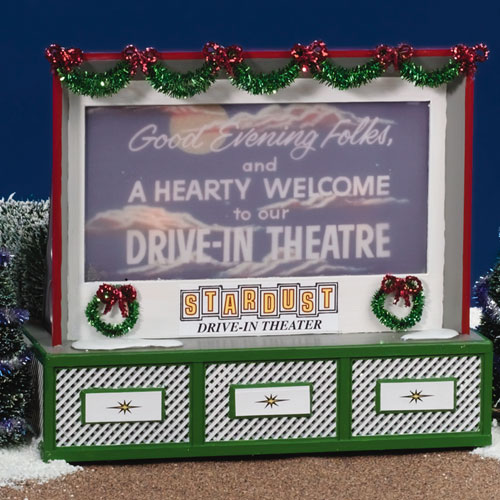
"Stardust Drive-In,"  #55064


QUESTION #3:  When, where and by whom was the first public cinema presentation?  In other words, when was the first movie shown in a theater to the public?

Answer:  On Dec. 28, 1895 the brothers  Auguste and Louis Lumiere had a showing of a series of short films, including the Arrival of a Train (L'Arrivee d'un Train,) at the Salon Indien du Grand Cafe in Paris.  The 10 short films were hand cracked through a projector and each ran approximately 50 seconds.  (Source:  http://mubi.com/films/arrival-of-a-train)


The two brothers had invented the Cinematograph, a machine which made and projected moving images. Within a few years, they had catalogued over a thousand films, all under a minute in length, frequently filmed in exotic locations.  Most were documentaries, though there were a few fictional scenes.

Auguste and Louis Lumiere,
making the decisions that
there was no money in movies.


Possessing no Steve Jobs-like vision, the Lumiere brothers decided there was little future in Cinematography and left the business in 1901.  (Source:  http://mubi.com/films/arrival-of-a-train)


Dept. 56, Snow Village,
"Rockability Records," #54880.
Carried the first film soundtrack.
QUESTION #4:  For what movie was the first soundtrack album released?

Answer:  The first commercially issued film soundtrack was for the 1937 Disney film "Snow White and the Seven Dwarfs."  Issued in Jan., 1937, the album was given the memorable label, "Songs from Walt Disney's Snow White and the Seven Dwarfs (with the Same Characters and Sound Effects in the Film of That Title.)"


What I think is the original poster for
"Snow White and the Seven Dwarfs."


If you are still reading this, you must, must, MUST, click on the following link to YouTube for a 1937 newsreel report on the premiere of "Snow White and the Seven Dwarfs" in 1937.  You'll see Marlena Dietrich, "Doug" Fairbanks, Shirley Temple with the Seven Dwarfs, and a very young Walt Disney.  Moreover, you will see how different Minnie and Mickey Mouse looked in 1937!  http://www.youtube.com/watch?v=ILBw0sz0Ahc


Dept. 56, Snow Village,
"Looney Toons Film Festival," #54983


QUESTION #5: What were some of the first types of movie memorabilia collected?

Answer:  The public started collecting movie memorabilia almost as soon as movies started: scrap-books, autographs, photographs, and industry magazines.  Nowadays there are complex licensing agreements to make and sell movie paraphenalia like stuffed animals, action toys, watches, key chains, and much more.


"The Wizard of Oz," poster, 1939.


Maybe the one item that most captures collectors'  imaginations, though, is the movie poster.  Originally, movie posters were distributed and delivered for the exclusive use of the theaters showing a film.  The posters were to be returned to the distributor after the film stopped playing.  The National Screen Service was the business which printed and distributed these posters between 1940 and 1984.  Posters were frequently in circulation for years, and were supposed to be returned for storage.  Of course, many ended up in collections.  The first film poster may have been 1895's "L'Arroseur Arrose," which you can see under Question #3 above.  (Source:  http://en.wikipedia.org/wiki/Auguste_and_Louis_Lumière)

Dept. 56, Christmas in the City,
"A Night on the Town," #59452


QUESTONS #6:   When and where was the first Hollywood premiere, as we know it.

Answer:  Presented by master showman Sid Grauman, the first gala premiere took place in 1922 at Grauman's Egyptian Theater in Hollywood.  The premiere was to celebrate the opening of "Robin Hood," the silent screen version with Douglas Fairbanks.  This very first premiere featured the bright lights and hoppla which have characterized the events ever since. (http://www.seeing-stars.com/meet/moviepremieres.shtml)

Dept. 56, Christmas in the City,
"The Grand Movie Theater," #58870


QUESTION #7:  Which was the most glamorous of movie premiers?

Well, it's in the eyes of the eyes of the beholder, but the most glamorous movie premiere may have been for "The Wizard of Oz" at Grauman's Chinese Theater in 1939.  Reputedly 10,000 people showed up for the event. The movie was MGM's most expensive production to date, and received two Academy Awards and a nomination for Best Picture of the Year.   The publicity splash did not help the show become a financial success, however.  It's initial release did not recoup the studios's investment, though subsequent releases did cover the costs.  By the way, the movie did receive the Academy Award for Best Original Song, "Over the Rainbow."  If you would like to see a YouTube clip of the film, with Judy Garland singing "Over the Rainbow," click here:  http://www.youtube.com/watch?v=es3vpC8gXKI  (Source:  http://en.wikipedia.org/wiki/The_Wizard_of_Oz_%281939_film%29)

Dept. 56, Christmas in the City,
"It's a Wrap," #807256


QUESTION #8:  What is the top-grossing film of all time?

Answer:  Calculating the measuring system for "top grossing' would require a Nobel Prize in Mathematics.  Suffice it to say that Wikipedia lists the following 5 top-grossing movies of all time:  1.  Avatar; 2.  Titanic; 3. Harry Potter and the Deathly Hallows-Part 2; 4.  Transformers:  Dark of the Moon; 5. The Lord of the Rings:  The Return of the King.


Dept. 56, Snow Village,
"Paramount Theater," #51420
QUESTION #9:  Who are the top-grossing movie actor and actress?

Answer:  For actor, did you guess Tom Cruise?  Tom Hanks?  Paul Newman?  WRONG!  Entertainment Weekly, the 300 pound gorilla in Entertainment News, just behind the National Enquirer, claims it is Samuel L. Jackson...? Not always top bill, Jackson has nonetheless been around in blockbuster films and just bust films for 2 decades, and it has all added up.  http://popwatch.ew.com/2011/10/27/samuel-l-jackson-highest-grossing-actor/  As a note to  stir the muddy waters, Comcast lists Tom Hanks as the top grossing actor....

Dept. 56, North Pole Village,
"Two for the Show," #56814


Now, for top actress: Not Julia Roberts, or Sandra Bullock or Jennifer Aniston.....the top grossing actress, according to Comcast, is Cameron Diaz!

Dept. 56, Snow Village,
"Dr. Seuss' how the Grinch Stole Christmas!", #55103
Maybe not the highest grossing animated film, but
a Christmas favorite, nonetheless!


QUESTION #10:  What is the top-grossing animated film of all time?

Answer: Drumroll, please.  With a worldwide gross of $1,063,171,911, Toy Story 3 is the highest-grossing animated film.  Auguste and Louis Lumiere, eat your heart out!

Thursday, January 19, 2012

Elvis Presley Trivia: With Buildings from Department 56 Original Snow Village and Christmas in the City

Elvis Presley, "Jailhouse Rock"
Album Cover, thanks to
Wikipedia for image.
The King of Rock.  "The King" is enough. Everyone knows it's Elvis.  And don't bother with the last name.  The list of his hits rolls through your memory:  "Can't Help Falling in Love;" "Don't Be Cruel;" "Heartbreak Hotel;" "Hound Dog;" "Return to Sender."  The list goes on and on, nearly 700 songs recorded, nearly 1 billion, with a "b," records sold worldwide, more than any other artist.  (You can click on this link to iTunes to hear a clip of each song, to revive your memory:  http://itunes.apple.com/us/album/dont-be-cruel/id253614038?i=253614095&ign-mpt=uo%3D4)


Elvis Presley's debut album.
Thanks to Wikipedia for the image.


Elvis's birthday was January 8, and this blog is written to honor him. Dept. 56 also celebrates Elvis:  He was one of the most prolific, influential, successful, iconic performers in the history of music.  It wasn't just his recordings that were successful.  The King brought his music to the new world of television, made movies, and became a cultural icon. Here are 10 trivia questions that will help you revisit the world that Elvis helped create for all of us:


QUESTION #1:  This is easy!  What is the name of Elvis's estate?  What do you know about it?

Dept. 56, Snow Village,
"Elvis Presley's Graceland" #55041
"Graceland" was the home that Elvis bought for himself and his parents in 1957.   Fans had  started to overrun their previous home in Memphis, so Elvis gave his parent $100,000 to find a better site, and to Graceland they moved.

Jungle Room in Graceland.
Thanks to Wikipedia for image.


Elvis put his own stamp on his new home, though many called his decorative style garish and tacky.  He directed and approved all the decor, made lists of food to be stored at Graceland, and created an unusual "family" to be installed around him, and it wasn't composed of just his relatives!


Dept. 56, Snow Village,
"Elvis Presley's Graceland Ornament," #98790


It was in the "Meditation Garden" at Graceland that Elvis, his mother and grandmother, are all buried. A memorial to his twin brother, Jess Garon, also stands in the Garden.  It was also in Graceland that Elvis died on Aug. 16, 1977.

One of the most visited private homes in the U.S., Graceland welcomes over 600,000 visitors every year.


QUESTION #2:  What did Elvis like to drive?

Dept. 56, Snow Village,
"Pink Cadillac Ornament," #98791
Another easy answer: Elvis liked Cadillacs and Harleys!  His most famous Cadillac may have been the 1955 Fleetwood he bought for his mother, Gladys, who actually never drove it.  While we all remember this car as pink, it was actually blue originally!  The pink version became an icon of not only Elvis, but also the entire decade of the 1950's, and some believe it to be the most famous car in the world.  If you want to learn more about ALL of Elvis's Cadillacs, click here:  http://elviscadillacs.tripod.com/

Dept. 56, Christmas in the City,
"Harley-Davison City Dealership," #59202
Elvis's love affair with the Harley-Davidson is equally celebrated.  One writer described it like this:  "As much as sequined jumpsuits and peanut butter and banana sandwiches, Elvis Presley loved Harley-Davidson motorcycles." Like his Cadillacs, Elvis would buy several, keep some, and give some away.

Elvis's parents, with 2 Cadillacs and his '56 KH.
http://www.scottymoore.net/elvisharley56kh.html
Elvis bought his first Harley in the early 1950's, and in 1956, just past his 21st birthday and days after he recorded "Heartbreak Hotel," he bought a KH model, the first of many.  For information on the Harley-Davidson Museum's exhibit of Elvis's Harleys, please click here:  http://onmilwaukee.com/music/articles/harleymuseumelvisexhibit.html

QUESTION #3:  How many platinum records did Elvis record?

Dept. 56, Snow Village,
"Elvis Presley's Autograph," #55106

In 1992, the Recording Industry Association of America (RIAA) posthumously awarded Elvis 110 gold or platinum, and multi-platinum albums and singles, the largest presentation in the history of the organization.  If you want to hear a YouTube clip of Elvis performing "Hound Dog," along with great hound images, click here:  http://www.youtube.com/watch?v=ZXiulKIgGpg 

QUESTION #4:  What is the TV show that first carried a performance of Elvis?
Dept. 56, Christmas in the City,
"The Ed Sullivan Theater," #59233
I bet many of you guessed The Ed Sullivan Show.  But you're wrong!  In 1956 Elvis' manager Colonel Tom Parker, negotiated 4 appearances on CBS's "Stage Show," which became his first television gigs.  Elvis received $1250 for each of 4 appearances, with an option for 2 more.  His first show was Jan. 28, 1956, and Elvis appeared with Sarah Vaughan and comic Gene Sheldon.  Tommy Dorsey introduced Cleveland disc jockey Bill Randle, who, in turn, introduced Elvis, who performed "Shake, Rattle, and Roll"  and "I Got a Woman."  If you would like to see both the introduction and the performance on YouTube, and you really should......click here:  http://www.youtube.com/watch?v=Ll8AzKY3gh4


Dept. 56, Snow Village,
"Now Showing-Elvis Presley Sign," # 55105
Ed Sullivan actually didn't want Elvis to appear on his show at all!  However, when the Steve Allen Show, featuring Elvis, garnered twice as many viewers as his own show, Ed relented. He ended up paying  Elvis the vast sum of $50,000 for three appearances, starting Sept. 9, 1956.  Sullivan himself was unable to introduce Elvis on the first night, since he was in the hospital recuperating from a serious automobile accident.  Instead, Charles Laughton hosted the show, and cut to a stage in Hollywood, where Elvis actually performed.  Laughton said during his introduction, "This is probably the greated honor that I've ever had in my life." 60 million viewers watched the show!  For more information, click here:  http://history1900s.about.com/od/1950s/qt/elvissullivan.htm


QUESTION #5:  What were the influences on Elvis' Music?


Postcard of Beale St., Memphis, TN, in the 1950's/60's.
Caption reads:  "World renowned as the home of W.C. Handy,
Father of American Blues Music."
http://www.memphismemories.org/Topics/Nightlife/Downtown_Nightlife/Beale_Street/Beale_Street.php 
You could write a book about the influences on Elvis's music, and just as many about his influence on subsequent generations of music stars.  Suffice it to say here, Elvis was influenced by contemporary pop and country, gospel, and the black rhythm and blues music of the Memphis's Beale Street.  One writer described it like this: "During the jazz age of the 1920's-1940's, musicians flocked to Memphis, and to Beale.  B.B. King, Louis Armstrong, Memphis Minnie and Muddy Waters were just a few of the jazz and blues legends who helped create the style known as 'Memphis Blues"--a style that was born on Beale Street.  In fact, a young white boy from Mississippi named Elvis ended up making a name for himself in the music world, thanks to the influence of the soulful, sensual music he soaked in while hanging around the jazz clubs, smoking parlors and brothels on Beale in the 1950's."  (Source:  Alyson McNutt English:  http://www.frontdoor.com/city-guide/memphis-tn-usa/beale-street-the-history-behind-the-memphis-party-scene)   

QUESTION #6:  How Many Movies did Elvis Make?

Dept. 56, Snow Village,
"Stardust Drive-In Theater," #55064
I bet you didn't get this!  Elvis made 31 movies!!  31! And that doesn't count two documentary films.  The first film was in 1956, "Love Me Tender," by Twentieth Century Fox.  That was soon followed in 1957 by "Jailhouse Rock," which featured co-star Jennifer Holden, and was put out by MGM.  For a list of all of Elvis's movies, click on this site:  http://www.elvis.com.au/presley/biography/elvis_presley_movies.shtml  In "King Creole' in 1958, Elvis starred opposite Walter Matthau, in a movie I am now going to rent!

We stayed at the Coco Palms on Kauai once, which is where "Blue Hawaii" was filmed.  Dilapidated now, the entire resort is boarded over and it is surrounded by a chain link fence.  It's just not right!

QUESTION #7:   When did Elvis serve in the U. S. military?

Dept. 56, Snow Village,
"Brand New Recruit," #55152
Elvis served in the U.S. Army between March, 1958, and March, 1960.  He refused an offer to enlist in the Special Services to entertain troops and live in priority housing, and decided instead to serve as a regular G.I.  (Though, to be honest, his service was anything but ordinary.)  According to Wikipedia, during his military duty, he was stationed in Germany, where a number of things happened that had a profound effect on Elvis's life:  First, his mother, Gladys, died, leaving him bereft.  Second, he met, in Germany, his future wife, Priscilla Beaulieu; and, Third, he began his drug use, that would ultimately be his downfall.

QUESTION #8:  Where were Elvis and Priscilla married?

Dept. 56, Snow Village,
"Wedding Chapel," #54640
It most assuredly was not a chapel like this.  In fact, Elvis Presley and Priscilla Beaulieu were married May 1, 1967 in the Aladdin Hotel in Las Vegas.  The hotel no longer exists, but the site is now occupied by the Wedding Chapel at Planet Hollywood.
Priscilla Beaulieu and Elvis Presley Wedding,
Alladin Hotel, Las Vegas
Image from http://www.elvispresleynews.com/ElvisWeddingPhotos.html 

QUESTION #9:  When did Elvis die?
Elvis Aaron Presley died Aug. 16,1977. Jimmy Carter credited Presley with having "permanently changed the fact of American popular culture." The funeral was at Graceland on Aug. 18, and approximately 80,000 peopled lined the processional route to Forest Hill Cemetery, where Presley was laid next to his mother.  Both bodies were later reburied in Graceland's Meditation Garden.


Wednesday, January 11, 2012

Details From a Department 56 Dickens' Village

An old Department 56 stork I
used as Christmas table centerpiece, 2012.


I find few things to enjoy about putting away my Christmas village displays.  One advantage, however, is that I take my time to look at each building and accessory carefully, as if I am saying good-bye to it for another year.  It isn't sad for me to do this, because I like returning our house to its lean, and uncluttered feel when all Christmas goes into hibernation.  It is, rather, enlightening.


Dept. 56, North Pole Village,
"Marie's Doll Museum," #56408 (Left;) "Ginny's Cookie
Treats," 56732, (Middle;) and "The Egg Nog Pub," # 56737,
(Right;) "Gumdrop Street Lamp," #52966


Before Christmas, when I put up my Dickens' village, I can't enjoy the details of each piece, because  there is so much to do!  Not only do I have to deal with the village lights and cords, but we have to move out the boxes, decorate the tree, put my burgeoning North Pole collection on the family room shelves, put up the lights outside, decorate the table....  I just want it over and done with! Then, when the village is ready and the lights go on, I see only the gestalt of the display: the skaters skating; the windmill turning; the lights gleaming through paned windows.  It is magical.  But I still don't notice the individual people, and accessories, and buildings.

Dept. 56, Dickens' Village,
"Kingsford's Brew House," #58114


It is when I put my Department 56 away that I notice the details.  It is then that I notice the hints that the designers have included to clarify the historical function of a building, or define what type of role the people are playing, or suggest  the cultural or social history of the era.  Sometimes the details just make me smile. This is why I decided to pick out 10 of my favorite details from my Dickens Village pieces, photograph them, and share them with you.


Dept 56, Dickens' Village,
Detail from
"Manchester Square: Lydby Trunk and Satchel Shop,"


Detail #10: I can just smell the leather of these satchels from the Lydby Trunk and Satchel Shop in the Manchester Square collection.  The trunks are placed outside the shop, and a freak storm has partially covered them with snow.  However, the leather has been so well-treated, that they can withstand the moisture.  To leave them outside under these conditions is confident advertising!  Notice, also, that there is a door frame on the left of the sign, and the stuccoing has not been completed.  Maybe an old entrance has recently been bricked over.


Dept. 56., Dickens' Village,
Detail from
"Mangrove Orangery," #58440


Detail #9:  One day I was considering the "Mangrove Orangerie," speculating about what botanical wonders would have grown inside in the midst of winter.  When I looked down through the glass roof panes, I saw the orange trees inside.  Of course!  Oranges for a Victorian Christmas feast!


Dept. 56, Dickens' Village,
Detail from
"C.H. Watt Physician," #55691


Detail #8:  Do you remember James Herriot, the author of All Things Great and Small and All Things Bright and Beautiful and other books about his adventures as a veterinarian in rural England?  Remember how his Yorkshire office was on the first floor of the house, and he lived on the second?  Well, Dr. Watt in Dickens' Village also lives in the same building as his office, though his residence entrance is outside and up the steps.  In an emergency, it would be easy to find the good doctor!


Dept. 56, Dickens' Village,
Detail from
"Manchester Square: Custom House,"
#58301 


Detail #7: The symmetry of the Customs House is reminiscent of the 19th century Shaker architecture in rural parts of the United States.  The columns of the portico, all of the windows, the Christmas trees, the balustrades, the staircases, and even the garlands wrapped around the columns all have mirror image symmetry. It is so controlled, and balanced, and grand!  Though it does leave me reeling to think that the are no handrails on the inside of the steps, which would be very dangerous if there was ice!  A barrister's dream, that omission.


Dept. 56, Dickens' Village,
Detail from
"The Wool Shop," #59242


Detail #6: Turrets and towers, all coned and capped, are always romantic and beautiful.  I suppose this is why I knew immediately I wanted The Wool Shop in my collection.  Not only does its tower have a lovely leaded window and corbels, but of course a vine is winding its way up the side.  I love how the turret is slapped onto the side of an ordinary building--more likely, actually, an ordinary building is slapped on the side of an old turret!


Dept. 56, Dickens' Village,
"White Horse Bakery," # 59269


Detail #5:  I find the silhouette of the horse on the sign for the White Horse Bakery just wonderful!  If you click here, you can read my February, 2011 blog about the white horses of England, and when I saw my first one:  http://christmasvillagefun.blogspot.com/2011/02/white-horse-bakery-homage-to-english.html  This building is one of just a several Dickens' Village pieces that I have a profound attachment to because of my personal experiences in England.  No "best" list of mine will ever omit the White Horse Bakery.

Dept. 56, The Original Snow Village Accessory,
"The Village Stone Footbridge," and
General Village Accessory, "Stone Footbridge,"
#52646 
Detail #4:  Isn't this bridge beautiful?  You can see the individual stones laid just right, the handmade bricks lining the rails, the grout, and on either end, large spheres to mark the entrances.  To make it even more evocative and lovely is the red holly that twines itself over the rough stones.  Sprinkled with snow and garnished with evergreens, I would never set up my village without this footbridge.  It is listed as a general village accessory, as well as The Original Snow Village accessory.

Dept. 56, Christmas in the City,
"Wintergarten Cafe," #58948
Detail #3:  I have always included the Christmas in the City "Wintergarten Cafe" in my Dickens Village, and I know some people include it in their Alpine Villages also.  When I first saw it, I just loved the copper brewing cauldron, and that continues to attract my attention.  But I also love this detail on the side, which is a row of kegs of the different kinds of beer that the Cafe dispenses:  German Lager, Weiss Bier, Classic Pilsner, and Winter Ale, all written in lovely script.

Dept. 56, Dickens' Village
"Old Michaelchurch," #55620


Detail #2:  This is the door of Dickens' Village "Old Michaelchurch."  The door is old and wooden, heavily bracketed, and set into the rock first floor of old spired wattle and daub church.  Old Michaelchurch actually looks very much like the church in which my husband and I were married almost 40 years ago!  That's one reason I like it.  The other reason I like it is that the door is ever so invitingly open.


Add caption


Detail #1:  This actually isn't a detail.  But for me, this little accessory sums up the entire Christmas experience.  That my picture came out fuzzy added charm for me.  Christmas memories are so ephemeral and yet so strong.  There are memories of decorations, and presents, and food, and music, and celebration.  For me, though, they are mostly memories of being with those I love.

Sunday, November 20, 2011

Patty Duncan's Trees in Department 56 Villages: Creative and So Cute!

"He who has not Christmas in his heart will never find it under a tree." 
(Roy L. Smith, from Quotegarden.com)

Several months ago I announced to my husband that the biggest village problem we have is trees.  Right now we only have two kinds: sisal pine trees and leafless birch.  Well, I do have one deciduous oak, but it is quite lonely.  

Patty Duncan, Tree Visualizer and Manufacturer Extraordinaire,
Founder and Vice President,
Southwest Villagers, Phoenix Area, Arizona
It was soon thereafter that someone on one of the chat rooms posted pictures from the Department 56 Happy Trails to Arizona Gathering.  Curious, I looked through them, and found TREES!  AND MORE TREES!  Trees by Patty Duncan, the Founder and Vice President of the Southwest Villagers Collectors Club in the Phoenix area! Patty has sent me a wonderful set of pictures, instructions for making trees, and ideas on how to craft trees to enhance specific buildings. And all these are Tree-mendous!


Patty Duncan's Trees used with Dept. 56 North Pole,
"Zenbolt's Handyman Shop," 808926


My favorites may be the trees Patty fashioned specifically for the North Pole building, Handyman Nutz Zenbolt.  First, she selected silver trees that go well with the corrugated silver roof on the shed, and the shiny metal parts all over the roof.   The trees in the back were from Walgreens last year.  On the far left and far right are trees from Lowes last year, onto which Patty glued nuts of various sizes, which mirror on the nuts on the building's chimney.  The large "bolt" trees are just that...bolts that Patty found and glued together!


Patty Duncan's Trees, used with Dept. 56,
North Pole,
"Baskets and Bows," #808925
Equally charming is the way Patty decorated the trees that complement the North Pole building Baskets and Bows.  Note that the tree on the left is wound with a garland, on which are both bows and wreaths with red bows.  These mirror the beautiful the red bows on the building above the windows, above the door, and even at the peak of the roof.  The tree on the right is simpler, but just as distinctive, using just bows.  I am sure you could make your own little bows from small ribbons, and even spray them with glitter.  You could also use puffy stickers, or Michaels other and craft sores will have tiny bows and wreaths designed for craft projects or dollhouses. In any event, the trees and the buildings create such a cute vignette it could stand alone, or enhance an entire village.

Patty Duncan's Trees, Used with Dept. 56, North Pole,
"Peppermint Pete's Candy Factory,"
#4016904 


Patty uses scrapbook or decorative paper in so many ways!  Here she cut out peppermint candy images from a sheet of the  scrapbook paper and stuck them onto a styrofoam tree with red and green decorative head pins she found at Michaels.  Just imagine how cute it would look if you made a walkway leading to Peppermint Pete's out of the same decorative sheets.  Patty has made me start thinking.  You could use actual wrapped peppermint candies glued onto styrofoam trees, or even red and white striped candy sticks, to mirror those on the building. 


Patty Duncan's Trees, in conjunction with Dept. 56, Christmas in the City,
"Golden Ox Market," # 805533, "Welcome to Chinatown,'" #807253,
"Tea Time," #799950


In Patty's Chinatown vignette, we see one of her most creative tree solutions.  Here she has taken Dept. 56 white birch trees, and hot glued on spring florals and pussy willow buds.  The vibrant fuchsia is so evocative of Chinese spring.  Patty's display features the Department 56 Christmas in the City, "Golden Ox Market," along with the CIC "Welcome to Chinatown" and the Dickens Village "Tea Time."

Patty Duncan's Trees, in conjunction with Dept. 56, Christmas in the City,
Jambalaya Cafe," #59265, "Caffe Tazio," #59253,
and "Handsome Cab," #59459


Patty's flamboyant use of Mardi Gras beads on trees enlivens a New Orleans vignette. She has not only wrapped the trees in beads, but even draped the "Handsome Cabs" with beads, and filled the carriages with gailey-wrapped presents.  In the background Patty has fashioned a background of green and purple fabric, traditional mardi gras colors.  Put together with the Department 56 Christmas in the City "Jamalaya Cafe" and "Caffe Tazio," a festive New Orleans scene is created. 


Patty Duncan's Trees.
Here are a series of trees, and the materials Patty recommends to use in making them. (Full instructions are at the end of this blog.)  In the back are Patty's red and green "Glittery Ball Trees," made from Hobby Lobby glitterballs, which were hot glued onto paper cone trees.  I wonder if you could also use little glass ornament balls?  On the gingerbread tree, front and left,  Patty used bric-a-brac and 3-dimensional scrapbook stickers in the shapes of Christmas bell, trees, and gingerbreads.  The gold trees in the back right are ornaments.  She snipped off the ornament hangers, and glued dowls onto the back so the trees could be supported by syrofoam.   The silver trees in the front center were also originally tree ornaments.  Patty glued them onto quarters to give them a base for standing, and then placed silver balls at the top to hide the ornament hooks!  On the front, right, is a simple evergreen tree, onto which Patty glued 3-D scrapbook figures of Mickey Mouse!

Patty Duncan's Trees, made from decorative paper.


In a women's magazine Patty saw a decorative tree idea, which she used for village applications!  (Patty's instructions are included at the end of this blog.)  Essentially, though, she cuts out circles of decorator or scrapbooking paper.  She folds them, and glues them onto skewers or small dowels, and tops them with stars from the same paper.


Patty Duncan's Trees, used with Dept. 56, Dickens' Village,
"Holly Tree Inn," #4016900
To the left you can see how Patty uses these kind of trees to enhance a display of Department 56 Dickens' Village Holly Tree Inn.  The decorative paper she used features garlands of holly with red berries, mirroring those in the Inn.  In the back on the right, by the way, is another example of Patty's technique of gluing 3-D stickers onto trees.  In this case, of course, the stickers are of holly leaves and berries.


Patty Duncan's Trees:
Autumn Pumpkin Display


Patty used the paper  technique described above to make autumn trees for use in a pumpkin display.  Notice how she has made the tops of the trees.  They are circles cut form the same paper, onto which Patty has applied autumn stickers featuring glitter leaves and rhinestones.  She found the stickers at Walmart.


Patty Duncan's Scary Trees!
"Halloween Trees"


Next year, when making your Halloween displays, remember Patty's Scary Tree technique. The Instructions are attached, below, under "Halloween Trees."  In short, using black scrapbook card stock, cut out 8 trees, then glue the bottoms, but not the tops, together.  Sprinkle black glitter onto a 9th cutout, and then glue that one on top of the stack of 8.  Glue a black dowel to the back of the trees, and fan the branches for dimension!  Wonderful effect.


Patty Duncan's Instructions for Christmas and Halloween Trees

     Spray paint green winter trees with black paint.  Decorate with glitter (I like Martha Stewart’s glitter).
     Hot glue flying ghost stickers to tree limbs of D56 trees (stickers are from Michaels).
     Paper trees are cut from black scrapbook card stock using a Cricut Electronic Cutter –Cartridge:  Paper Doll Dress Up-Frankenstein Accessories 3.  Glue bottom halves of 8 cutouts together.  Do not glue branches – only trunk of trees. Spray adhesive glue on 9th cutout and sprinkle with black glitter then glue in on top of stack of 8.   Glue black painted dowel to back of trees to stand up in foam base.    Fan branches to add dimension.

Christmas Trees:
    Theme trees are easy to make.  Use scrapbook stickers or any embellishment that depicts the theme.  Hot glue in winter trees (Jolee’s 3 dimensional stickers are great).
    Peppermint Trees are also made from scrapbook decorative paper.  Cut peppermints out and stick pin to Styrofoam cone tree with decorative pins.
   Glitter Ball Trees.  Glue balls to paper cone trees with hot glue.  Glitter balls can be found at Hobby Lobby.
   Oriental Trees.   Hot glue Spring florals & greenery to D56 white birch trees.  Shape branches to allow florals to hang.
   Mardi Gras Trees.   Cut string of beads and hot glue to trees to replica beads thrown during Mardi Gras.  D56 bejeweled trees are perfect for this theme.
   Ornaments.    Use “tree” ornaments for an unique addition to your display.  Add base and tree topper.

Patty Duncan's Instructions for Three-tier Trees

Prep:   Cut three circles from decorative paper.  Scrapbook cardstock works best for sturdier trees.
Each circle should be ½ inch larger than the previous.  The circles for our trees are:  4½ inches, 3½  inches and 2¾ inches.  (I liked the look of 2¾ instead of 2½.)
Fold each circle in half four times.  When using heavier paper, you may have to make the last folds individually.  Unfold to reveal the “pleated” circles.
Snip a very small amount off the tip of each folded circle.
Assembly:  Thread the circles, largest one first, onto a painted wooden skewer. (do not glue yet)
Finish:  For the topper, glue two stars back-to-back over the top of skewer.  You can use other shapes for topper:  snowflake cutout or circle with designs from paper you are using.
Slide pleated circles into place on skewer and glue if needed on the underside (at skewer).  You can place & glue top pleated circle right up to your topper, or leave a space showing painted skewer between them.
Decorate tree with glitter glue, beads, or any small decorative item.
  Cut the skewer even with the bottom circle so the tree    will stand up, or leave some length to poke through   styrofoam in your village display.
  Decorate:  You can decorate your tree with scrapbook embellishments, glitter glue, and/or small buttons in the small design that is in your paper.  To make trees taller, add one or more tier(s) made ½ inch large than last circle.